Fewer Tests, More Confidence
A Rails Testing Philosophy for the AI Era
Ifat Ribon
Rocky Mountain Ruby | 09.2026
AI can generate tests fast...
...but it's not free
More to review
More to reason about
More to maintain
More to wait for in CI
More money

AI can generate more testsbut not always better tests
Define a Testing Philosophy
TESTING PHILOSOPHY
Why We Test
1
Validate code meets requirements
2
Protect essential user flows & business logic
3
Catch key failure states & critical interdependencies
4
Enable refactoring with confidence



Tests document requirements...and now they serve as context
TESTING PHILOSOPHY
Test Categories
Unit
Logic in isolation
Best for model specs and edge cases
System
User experience, integrated components
Best for happy paths in key user flows
Integration
How components fit together
Best for external dependencies and complex flows
TESTING PHILOSOPHY
The Test Pyramid
UNIT
Fast · Cheap
SYSTEM
Moderate
INTEGRATION
Slow · Expensive
Less Granular
More Expensive More Granular
Less Expensive
More Expensive More Granular
Less Expensive
TESTING PHILOSOPHY
Testing Principles
01
Test behavior,
not implementation
not implementation
02
Keep tests
deterministic
deterministic
03
Balance coverage
with cost
with cost
04
Use good test design to
promote good code design
promote good code design
TESTING PHILOSOPHY
Testing Principles
01
Test behavior,
not implementation
not implementation
02
Keep tests
deterministic
deterministic
03
Balance coverage
with cost
with cost
04
Use good test design to
promote good code design
promote good code design
TESTING PHILOSOPHY · PRINCIPLE 01
Test Behavior, Not Implementation
Avoid testing library / language code
Focus on public methods and their results
Assert tests pass after refactors
❌ Implementation-coupled
test "calculates the discount" do
order = Order.new(total: 100)
assert_equal 10, order.send(:calculate_discount)
end
✅ Behavior-focused
test "applies discount to eligible order" do
order = Order.new(total: 100, promo: "SAVE10")
assert_equal 90, order.discounted_total
end
A good test survives refactors
TESTING PHILOSOPHY
Testing Principles
01
Test behavior,
not implementation
not implementation
02
Keep tests
deterministic
deterministic
03
Balance coverage
with cost
with cost
04
Use good test design to
promote good code design
promote good code design
TESTING PHILOSOPHY · PRINCIPLE 02
Keep Tests Deterministic
Keep data local
Stub collaborators in unit/system tests
Control time when it affects behavior
❌ Flaky — time-dependent
test "trial is active during the window" do
user = User.create!(trial_ends_at: 3.days.from_now)
assert user.trial_active?
end
✅ Deterministic — frozen time
test "trial is active during the window" do
travel_to Time.zone.parse("2026-06-01 12:00") do
user = User.create!(trial_ends_at: "2026-06-04 12:00")
assert user.trial_active?
end
end
A failing test means something is broken — not "try re-running"
TESTING PHILOSOPHY
Testing Principles
01
Test behavior,
not implementation
not implementation
02
Keep tests
deterministic
deterministic
03
Balance coverage
with cost
with cost
04
Use good test design to
promote good code design
promote good code design
TESTING PHILOSOPHY · PRINCIPLE 03
Balance Coverage with Cost
Choose test types intentionally
Minimize data setup
Avoid testing external dependencies directly
❌ System test for pure logic
test "applies promo discount" do
visit new_order_path
fill_in "Promo code", with: "SAVE10"
click_on "Apply"
assert_text "$90.00"
end
✅ Unit test — same confidence, far cheaper
test "applies promo discount" do
order = Order.new(total: 100, promo: "SAVE10")
assert_equal 90, order.discounted_total
end
Reach for the cheapest test that gives confidence
TESTING PHILOSOPHY
Testing Principles
01
Test behavior,
not implementation
not implementation
02
Keep tests
deterministic
deterministic
03
Balance coverage
with cost
with cost
04
Use good test design to
promote good code design
promote good code design
TESTING PHILOSOPHY · PRINCIPLE 04
Use Good Test Design
Tests should have a single reason to fail
Results should be objective and discrete
Failures are actionable and specific
❌ Multiple reasons to fail
test "user signup" do
user = User.create!(name: "Jo", email: "jo@ex.co")
user.sign_up!
assert user.confirmed?
assert_equal "free", user.plan
assert user.welcome_email_sent?
end
✅ Single reason to fail
test "new user gets the free plan" do
user = User.create!(name: "Jo", email: "jo@ex.co")
user.sign_up!
assert_equal "free", user.plan,
"Expected new signups to default to free plan"
end
A convoluted test points to convoluted code
Rein in the Agent
HARNESS THE AGENT
AI Test Flow
Generate
AI
→
Review
Human
→
Prune
Collab
→
Harden
Collab
→
Capture
AI
order_test.rb — 14 tests generated 🤖
test "applies promo discount to eligible order" do
order = Order.new(total: 100, promo: "SAVE10")
assert_equal 90, order.discounted_total
end
test "discount never drops total below zero" do
order = Order.new(total: 5, promo: "SAVE100")
assert_equal 0, order.discounted_total
end
test "pending? returns true when status is pending" do
order = Order.new(status: :pending)
assert order.pending?
end
test "discounted_total returns a reduced total" do
order = Order.new(total: 100, promo: "SAVE10")
assert_operator order.discounted_total, :<, 100
end
HARNESS THE AGENT
AI Test Flow
Generate
AI
→
Review
Human
→
Prune
Collab
→
Harden
Collab
→
Capture
AI
HARNESS THE AGENT
Reviewing Tests
00Does it do what it says?
The description is the spec. The body is the proof.
01Behavior
Tests library, framework, or language code instead of custom logic
Tests private methods or implementation details
Would break on an internal refactor that doesn't change behavior
02Determinism
Relies on data outside the system under test
Hits real collaborators (HTTP, queues, mailers) in a unit or system test
Depends on execution order or shared mutable state
03Balance
Uses a heavier test type than the behavior requires
Creates superfluous data that isn't needed for the assertion
Hits external dependencies directly in a unit or system test
04Design
Has multiple reasons to fail
Produces ambiguous or non-discrete results
Fails with a message that doesn't tell you what broke or why
order_test.rb — keep or delete? 🔍
# ✅ Core behavior — keep
test "applies promo discount to eligible order" do
order = Order.new(total: 100, promo: "SAVE10")
assert_equal 90, order.discounted_total
end
# ✅ Edge case worth preventing — keep
test "discount never drops total below zero" do
order = Order.new(total: 5, promo: "SAVE100")
assert_equal 0, order.discounted_total
end
# ❌ Tests Rails' enum machinery, not your app — delete
test "pending? returns true when status is pending" do
order = Order.new(status: :pending)
assert order.pending?
end
# ❌ Redundant with the first test — delete
test "discounted_total returns a reduced total" do
order = Order.new(total: 100, promo: "SAVE10")
assert_operator order.discounted_total, :<, 100
end
HARNESS THE AGENT
AI Test Flow
Generate
AI
→
Review
Human
→
Prune
Collab
→
Harden
Collab
→
Capture
AI
HARNESS THE AGENT
Make the Suite Lean
Cut the noise!
Delete what failed review: tests of the framework, redundant duplicates, brittle one-offs.
Merge the dupes!
Consolidate overlapping tests. Extract shared setup into helpers and factories.
Shape what stays!
Refactor the keepers to match suite conventions. Tests are code, so hold them to the same bar.
Be ruthless about deleting low-value, brittle, or redundant AI-generated tests!
order_test.rb — pruning the suite ✂️
# ✅ Core behavior — keep
test "applies promo discount to eligible order" do
order = Order.new(total: 100, promo: "SAVE10")
assert_equal 90, order.discounted_total
end
# ✅ Edge case worth preventing — keep
test "discount never drops total below zero" do
order = Order.new(total: 5, promo: "SAVE100")
assert_equal 0, order.discounted_total
end
# ❌ Tests Rails' enum machinery, not your app — delete
test "pending? returns true when status is pending" do
order = Order.new(status: :pending)
assert order.pending?
end
# ❌ Redundant with the first test — delete
test "discounted_total returns a reduced total" do
order = Order.new(total: 100, promo: "SAVE10")
assert_operator order.discounted_total, :<, 100
end
HARNESS THE AGENT
AI Test Flow
Generate
AI
→
Review
Human
→
Prune
Collab
→
Harden
Collab
→
Capture
AI
HARNESS THE AGENT
Fill the Gaps
Hunt for missing cases!
Find edge cases the suite doesn't cover, e.g., nil, empty, boundary values, unauthorized access.
Generate variants!
Same behavior, hostile inputs, e.g., zero totals, expired promos, duplicate submissions, missing records.
Prove it catches bugs!
Introduce plausible bugs into the code. Every one the suite misses is a test you're missing.
The pruned suite is lean, now make sure it's complete!
order_test.rb — filling the gaps 🛡️
# ✅ Core behavior — keep
test "applies promo discount to eligible order" do
order = Order.new(total: 100, promo: "SAVE10")
assert_equal 90, order.discounted_total
end
# ✅ Edge case worth preventing — keep
test "discount never drops total below zero" do
order = Order.new(total: 5, promo: "SAVE100")
assert_equal 0, order.discounted_total
end
# 🛡️ Edge case added — unknown code
test "unknown promo applies no discount" do
order = Order.new(total: 100, promo: "BOGUS")
assert_equal 100, order.discounted_total
end
# 🛡️ Edge case added — missing promo
test "nil promo leaves total unchanged" do
order = Order.new(total: 100, promo: nil)
assert_equal 100, order.discounted_total
end
HARNESS THE AGENT
AI Test Flow
Generate
AI
→
Review
Human
→
Prune
Collab
→
Harden
Collab
→
Capture
AI
HARNESS THE AGENT
Bolster the AI Harness
Rules
Codify hard constraints and convetions: what to avoid, what patterns are banned, how to review its output.
RULE.md
# Testing Rules
## Principles
1. **Test behavior, not implementation.** Test public methods and their observable results. Do not test Rails internals, Ruby stdlib, or gem code. Tests must not break when internals are refactored.
2. **Keep tests deterministic.** Data is local to each test. Stub external collaborators. Control time with `travel_to`. Never depend on record ordering without an explicit `ORDER BY`. A failing test means something is broken — not "try re-running."
3. **Balance coverage with cost.** Choose the cheapest test type that gives confidence: unit for logic, system for user flows, integration for external contracts. Minimize data setup — only create data the assertion requires. Stub HTTP/APIs/filesystem in unit and system tests.
4. **Good test design promotes good code design.** One reason to fail per test. Objective pass/fail. Actionable failure messages. If a test is hard to write, simplify the code under test.
## Review checklist
Start with the gate. Then check the twelve red flags. Every test — written or generated — must pass the gate and be clean of all twelve flags. If any flag is true, fix or delete the test.
### 00 · Does it do what it says?
The test name makes one claim about behavior. The assertions prove that claim and nothing else.
### 01 · Behavior
- Tests library, framework, or language code instead of custom logic
- Tests private methods or implementation details
- Would break on an internal refactor that doesn't change behavior
### 02 · Determinism
- Relies on data outside the system under test
- Hits real collaborators (HTTP, queues, mailers) in a unit or system test
- Depends on execution order or shared mutable state
### 03 · Balance
- Uses a heavier test type than the behavior requires
- Creates superfluous data that isn't needed for the assertion
- Hits external dependencies directly in a unit or system test
### 04 · Design
- Has multiple reasons to fail
- Produces ambiguous or non-discrete results
- Fails with a message that doesn't tell you what broke or why
## Conventions
- `Minitest::Test` for units, `ActionDispatch::SystemTestCase` for system tests.
- Name methods `test_<description_of_behavior>` — should read as a sentence. If the name has "and" in it, split the test.
- Prefer `assert_equal`, `assert_nil`, `assert_includes`, `assert_raises`, `assert_difference` over bare `assert`.
HARNESS THE AGENT
Bolster the AI Harness
References
Give AI documentation and examples: the docs, guides, and example tests the agent should draw from.
references/unit_tests.md
## Unit Test Best Practices
Unit tests go in `test/models/`, `test/services/`, `test/jobs/`, `test/mailers/`, or the appropriate directory mirroring `app/`.
```ruby
require "test_helper"
class WidgetTest < ActiveSupport::TestCase
setup do
# minimal shared context — only what multiple tests need
end
test "calculates total price from quantity and unit price" do
widget = Widget.new(quantity: 3, unit_price: 10_00)
assert_equal 30_00, widget.total_price
end
end
```
When using fixtures or factories, build only the attributes relevant to this test.
When the method under test calls an external service, API client, or mailer, stub that call. When behavior depends on time, wrap the test in `travel_to`.
HARNESS THE AGENT
Bolster the AI Harness
Skills
Teach AI how to write and maintain the suite: point it to the tools and conventions it should use.
SKILL.md
---
name: test
description: Generate and maintain Minitest tests for a Rails application. Use this skill whenever the user asks to write tests, add test coverage, review existing tests, fix a failing test, or mentions testing in the context of a Rails + Minitest codebase.
---
# Testing
This app uses minitest and relies on fixtures over factories.
In this app the following semantics are used:
1. Unit tests - isolated and discrete business logic.
2. System tests - user behavior and experience, capybara tests
3. Integration tests - Third-party integrations and complex interdependencies (full backend workflows, including database triggers)
There are several references on best practices for writing minitests, and strong test coverage in general. These are captured in the references folder and listed below.
These *must* be read before writing, reviewing, or refactoring any test:
1. [Testing Rules](../../rules/test-rules.md)
2. [Minitest Rules](../../rules/minitest-rules.md)
3. [Test Style Guide](../../rules/test-style-guide.md)
Tests for specific areas of the app should leverage the below references. Review each one if you are attempting tests in a given area:
1. [Unit Tests](./references/unit_tests.md)
1. [Model Tests](./references/model_tests.md)
1. [Controller Tests](./references/controller_tests.md)
1. [System Tests](./references/system_tests.md)
## Before writing any test
1. **Read the references** if you haven't this session. The rules there are authoritative.
2. **Identify the behavior under test.** State it in one sentence. If you can't, the scope is too broad, split it.
3. **Choose the right test type.** Logic in isolation → unit test. User-facing flow → system test. External contract → integration test.
4. **Check for redundancy.** Scan existing tests for the file or class. Do not duplicate coverage that already exists.
## Running the Tests
- Unit tests: `bin/rails test`
- System tests: `bin/rails test:system`
- Integration tests: `bin/rails test:integration`.
- Single file with `bin/rails test test/models/user_test.rb`, or single example with `...:42`,
## How to maintain the suite
Tests accumulate debt like any other code. When the codebase evolves:
- **Extract shared setup** into helpers (`test/support/`) or factory methods when the same creation logic appears in three or more files.
- **Replace repeated inline stubs** with a shared helper method.
- **Rename tests** whose names no longer match the behavior they verify.
- **Refactor tests alongside the code they test.** When a model changes shape, update its tests in the same PR.
- **Delete aggressively.** Tests that cover dead behavior, test framework code, or duplicate another test are liabilities. Remove them and note why in the PR.
## How to explain your work
When you generate tests, briefly note in your summary what each test covers and why it's worth having. This helps reviewers curate faster and builds trust in the AI workflow. When you flag a test for deletion, cite the specific rule it violates.
How do we know it's better?
HARNESS THE AGENT · MUTATION TESTING
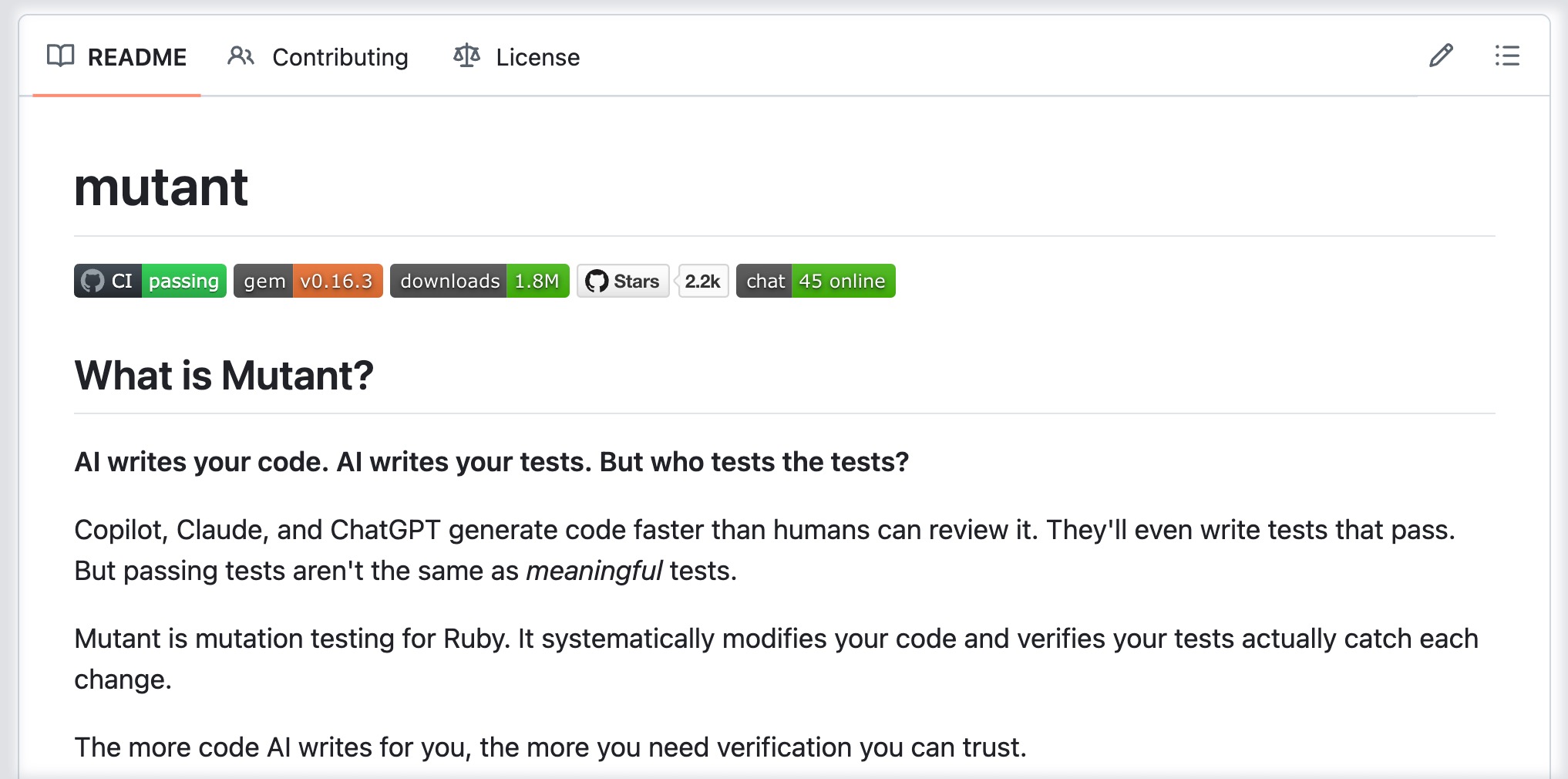
Meet Mutant
Spawns tiny mutations in your code
Runs the test suite against each mutant
Inspect survivors — missing test or dead code?
Kill survivors with new tests or simpler code

HARNESS THE AGENT · MUTATION TESTING
Mutant in Action
lib/person.rb
def adult?
@age >= 18
end
test/person_test.rb
test "adult at 19" do
assert Person.new(age: 19).adult?
end
test "not adult at 17" do
refute Person.new(age: 17).adult?
end
# ✅ Tests pass · 100% line coverage
lib/person.rb
def adult?
@age >= 18
end
def adult?
- @age >= 18
+ @age > 18
end
test/person_test.rb
test "adult at 19" do
assert Person.new(age: 19).adult?
end
test "not adult at 17" do
refute Person.new(age: 17).adult?
end
# ✅ Tests still pass
Boundary case was never tested, the mutant survived
HARNESS THE AGENT · MUTATION TESTING
Mutant in Action
app/models/order.rb
def total_price
if line_items.any?
line_items.sum(:price)
else
0
end
end
test/models/order_test.rb
test "sums line item prices" do
assert_equal 30, orders(:with_items).total_price
end
test "empty order returns 0" do
assert_equal 0, Order.new.total_price
end
# ✅ Tests pass · 100% line coverage
app/models/order.rb
def total_price
if line_items.any?
line_items.sum(:price)
else
0
end
end
def total_price
- if line_items.any?
- line_items.sum(:price)
- else
- 0
- end
+ line_items.sum(:price)
end
test/models/order_test.rb
test "sums line item prices" do
assert_equal 30, orders(:with_items).total_price
end
test "empty order returns 0" do
assert_equal 0, Order.new.total_price
end
# ✅ Tests still pass
The guard never changed the result, the mutant survived
HARNESS THE AGENT · MUTATION TESTING
Evil Mutant
Modified boundaries (
>= → >)Removed side effects
Changed return values
Deleted conditional branches
Add the Missing Test
Defensive code that can't trigger
Speculative branches nobody asked for
Redundant expressions (
.to_s on a string)Dead / unreachable code paths
Simplify the Code
HARNESS THE AGENT
Bolster the AI Harness
Deterministic Tools
Code scanning and coverage tools can objectively verify what the test suite actually catches.
Gemfile
source "https://rubygems.org"
group :test do
# the floor — "Did this code run during tests?"
gem "simplecov"
# the gate — "Is the code I just changed tested at all?"
gem "undercover"
# the deep check — "Would tests notice if this code changed?"
gem "mutant"
end
group :development do
# the sweep — "Is this code still alive?"
gem "debride" # methods nothing calls
gem "keela" # methods, scopes, constants, partials… with a baseline
end
group :production do
# the cleanup — "Is this code even used in production?"
gem "coverband"
end
Fewer tests.More confidence.
thank_you_test.rb · passing
test "thanks for listening" do
assert_equal :grateful, speaker.mood
end
# Finished in 0.09s
1 runs, 1 assertions, 0 failures, 0 errors, 0 skips ✓
iribon9@gmail.com
linkedin.com/in/ifatribon